
Four historic pubs, from the Wheatsheaf Inn (built 1611) to the Plasterers Arms: timber frames, hanging signs and old brick.
See all 4 stepsWhat you'll be able to do
- Materials You don't need an art shop haul. Ian uses basic tools - hot-pressed paper, a handful of Tombow brush pens, two or three brushes. That's it. He shows you exactly what to buy and why.
- Thought Process This is what separates Ian from YouTube tutorials. He doesn't just draw - he tells you why he's drawing. Every decision explained. Every choice visible.
- Composition Where to start on the page. How to frame the building. How much sky to include. The decisions most beginners agonise over - answered before you pick up a pen.
- Outline Ian's approach to getting the basic structure down without overthinking it. Loose, confident, forgiving. Not architectural drawing - storytelling with lines.
- Shapes How to break a complex pub facade into simple shapes you can actually draw. Windows, doors, chimneys, roof lines - simplified without losing character.
- Colours Three colours. That's often all Ian uses. You'll learn how restraint creates more atmosphere than a full palette - and how to let the paper do half the work for you.
- Detail "The things that are exaggerated are the things that you find really interesting." Ian's detail philosophy in one sentence. You learn to push the things that fascinate you and let the rest fade.
About this course
Overview
Four Old Pubs. One Sketch System. Zero Talent Required.
Here's what nobody tells you about sketching old pubs.
The front of a pub is flat. That sounds obvious - until you realise what it means for you with a pen in your hand.
Most buildings terrify beginners because you're wrestling three dimensions onto a flat page. Vanishing points. Perspective lines. Rooftops at angles that make your head swim.
A pub facade eliminates all of that.
As Ian Fennelly puts it: "The front facade almost acts as your general structure, your blank page, and then within that page you can start populating it with loads and loads of detail."
The timber beams, the window frames, the old doorway - they create a natural grid that holds your sketch together.
You are not fighting perspective. You are freed from it. And once you are freed from it, something remarkable happens: you stop worrying about getting it right, and you start enjoying getting it down.
That is what this course is built around. Four real British pubs. Four workshops. A framework so forgiving it works whether you have been sketching for years or have never picked up a pen.
Your Lessons
Who it's for
I'm a complete beginner. Is this really for me?
Absolutely. And you're not alone in wondering.
Angela Pound started this course at 79 years old: "Who would have thought at the age of 79 I would learn to sketch from a great artist like Ian."
Ken Wire put it even more plainly: "I have zero artistic talent, but Ian convinced me to try something and I was pleased with my results."
Ian's teaching style is calm, step-by-step, and built for people who have never sketched before. He doesn't assume you know anything. He starts from scratch and walks with you. And the pub facades themselves are forgiving subjects - flat, framed, full of character. The building gives you the structure. You bring the pen.
Your learning path
4 workshops, in the order Ian teaches them. Work through them at your own pace; every step ends with a finished sketch.
Before you start
Beginner level
No experience needed. Ian starts every workshop from a pencil and a blank page and builds the sketch one stage at a time.
Workshop 1
The Wheatsheaf Inn (Built 1611)
This timber-frame beauty has been standing since James I sat on the throne. Ian uses it to introduce the idea that changes everything: the front of a pub is your blank page.
You'll practise
- Lay brush pens on the blank page to test where the roof, walls and base will sit.
- Mix violet with ultramarine to get a deep dark for the beams without using black.
- Draw the dark space between the cobbles so they stand out and ground the bottom of the picture.
Read the full workshop notes
Front Elevation as Canvas
In his words: "Using the framework, the front elevation, as almost like a page to write your visual story."
He walks you through his Layers of Looking sequence - building the sketch in layers so nothing overwhelms you. Then the Distressed Window technique, where you learn to make old glass look like it's been warping for centuries.
The building does the heavy lifting. You just learn to see it.
Workshop 2
The Anchor
This is the module that saves you from yourself.
You'll practise
- Treat the plain front of the pub as a blank page, then fill it with what you notice.
- Keep the footpath signpost for its context and structure, and leave out the ugly green junction box.
- Build the pub name in stages: brush pen guide, bold fine liner letters, then shading behind them.
Read the full workshop notes
The Three-Reason Inclusion Test
Every beginner makes the same mistake: they try to draw everything. Every brick, every drainpipe, every trash can. The sketch ends up looking like an inventory, not a piece of art.
Ian's Three-Reason Inclusion Test is a simple editing framework. Before anything goes into your sketch, it needs to earn its place. If it doesn't pass the test, it stays out.
This single idea could save you years of overworked, cluttered sketches. It's the difference between a police report and something you'd actually hang on your wall.
Workshop 3
The Plasterers Arms
The first two pubs gave you structure and editing. Now Ian lets you play. His description is perfect: "Step one and step two are almost like trying to create a playground for yourself and now I'm going to go into that playground…
You'll practise
- Move about ten metres sideways to find the satellite dish, rather than drawing from one fixed spot.
- Sketch the lettering lightly in brush pen first, so the whole name fits before fine liner.
- Lift black from the windows with clean water for a weathered look, then sharpen with fine liner.
Read the full workshop notes
The Playground Method
This is where the course shifts gears.
The first two pubs gave you structure and editing. Now Ian lets you play. His description is perfect: "Step one and step two are almost like trying to create a playground for yourself and now I'm going to go into that playground and I'm going to play."
And then: "So it's been very much about observation and the eye, now it's about the heart."
That's the moment. When it stops being an exercise and starts being something you actually feel. The pub isn't a test - it's your excuse for being creative.
Workshop 4
The Hooton Arms
Pub signage. Hand-painted lettering. The names above the door that tell you this is a place with a story.
You'll practise
- Lay pens on the blank page to preview the tilt and wrap of the building before marking it.
- Paint the black timber frame in Prussian blue and crimson instead of black, then add tone later.
- Draw the dark space around white lettering so it pops, and use thick white paint on dark signs.
Read the full workshop notes
Lettering, Heart, and the Final Layer
Pub signage. Hand-painted lettering. The names above the door that tell you this is a place with a story. Ian teaches you negative and positive drawing - two approaches to capturing the details that give a pub sketch its personality.
And then this: "So it's been very much about observation and the eye, now it's about the heart."
The things you exaggerate are the things you love. The details you linger on are the details that matter to you. By this point, you are not copying a building. You are telling its story - and your own.
When you finish
What you'll have at the end
4 finished sketchesOne for every step, in your own sketchbook.1 bonusExtra workshops and resources to keep going.Yours to keepCome back to any lesson whenever you like.
Why Pub Sketching Course?
Four pubs, one method
Every pub follows the same layers: brush pen outline, fine liner, colour, brush pen tone, then detail, from the Wheatsheaf Inn of 1611 to the Hooton Arms.
Lettering that fits
Signs, lettering, wires and lamps are drawn to match the rest of the picture, and pub names are built in stages so the whole name fits.
Invent the colour
Black and white buildings become a playground: you invent colour freely, using one palette across all four pubs, and paint dark timbers without reaching for black.
Ready when you are
Start Pub Sketching Course today
Short lessons, yours to keep, and a 30-day money-back guarantee.
What else comes with the course
1 extra workshop and resources are part of the course, so the learning carries on after the last location.
Included with this course
Dublin Sketching Bonus Module - FREE with your course.
About your instructor
Ian has been called "the Bob Ross of urban sketching" - and the comparison fits. Calm voice. Step-by-step approach. A knack for making you believe you can actually do this.
He's a globally recognised urban sketching artist, author of Layers of Looking, and has taught thousands of students across multiple countries. He's led in-person retreats from Brighton to Chester, and built a body of online courses.
His thing? He doesn't teach you to copy. He teaches you to see - and then gives you a system to get what you see onto the page.
Sketches by students of this course
What students say
I’ve survived cancer, so now enjoying life with my family and relaxing with my new found skills in art. Can’t wait for the next challenge of Ian’s Urban Sketch+ course.
David Donnelly
The course for beginners was a great benefit for me. I really learned a lot, how to phase my work, how to make perspective, how to make and use presketch, how to mix colours and use water, toning... My pictures got depth and look better. Thank you very much.
Andrea Kolarikova
I am home bound and can't go out to sketch, but thanks to these wonderful tutorials I can sketch along and have the joy of painting.
Melissa McCutcheon
I absolutely loved the four pub series! I was totally absorbed in drawing each pub and with each new pub, I leaned into just letting my pens and brushes do the talking! I think one of the take aways for me was when Ian "walked into the scene". That made such a difference. Helped bring each location to life. A friend said my drawings looked like drunken pubs. I thought that was absolutely perfect. That's what I wanted them to look like. I think I am in love with UK pubs. I hope I get a chance to draw a few live.
Vicki Barnes · Review on Trustpilot
Great fun, looking forward to next pub. Love Ian's chats, keeps me company while working ☺️
Shirley Rowley
My version of the Hooton Arms, pleased with the overall result but always room for improvement.
Gary Wild
I love the energy, freedom and whimsical freshness Ian infuses into his creations and his instruction... I am slowly finding my own voice with his inspiration and find the way he breaks down his process into manageable steps very helpful.
Carolyn Gawalko
Ian is a fantastic teacher with a very well structured way of teaching which makes it easy to follow and understand. I have since signed up for the Urban + course
Philip Smith
I am now hooked on splashing the paint on with lots of water and, in Ian’s words, letting the colours play together. I have also, at last, found a way of sketching trees that I enjoy. Ian’s approach is a joy to do.
Pam Rhodes
I’ve enjoyed this one so much!
Chris Fontaine
Really enjoyed the course, and very pleased with my results
Mandy Asquith
Ian brings joy and exploration energy to learning. While he has specific techniques he imparts, his enthusiasm for playing around comes through and is infectious. Several people noticed the shift in what I was making once I started with him. It’s now been 4 years, and I’ve loved all of it.
Gretchen Anderson
I live in a small town that has very ordinary buildings. It is a tourist town so there are interesting things about, but the structures themselves don't give a lot of inspiration. I have taken several courses from Ian, and the tips in this one have been very helpful because it has helped me the structures differently. I was stuck painting white buildings white and black trim black. This help me envision my town differently. I still paint like I paint but I see and plan differently. The tips throughout are spectacular and Ian's personality is infectious.
Mike Martin · Review on Trustpilot
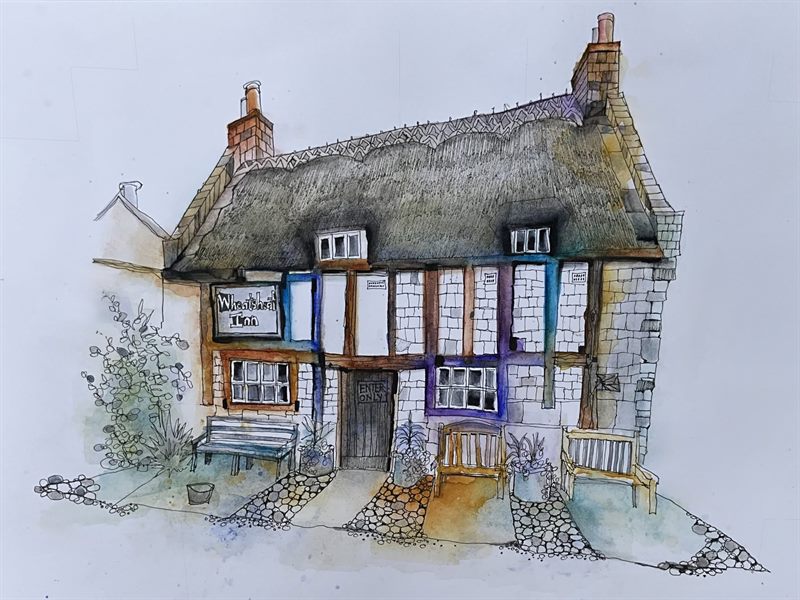
Finally finished the Pub course ( ok, not quite, still busy with the Dublin pubs) This was so much fun!
Lerie Lewen
So much fun to do with Ian in Australia.
Lindy Hyam
I loved all the plants and textures of the stone wall.
Denise Wolverton
this was quite fun.
Karen Mirande
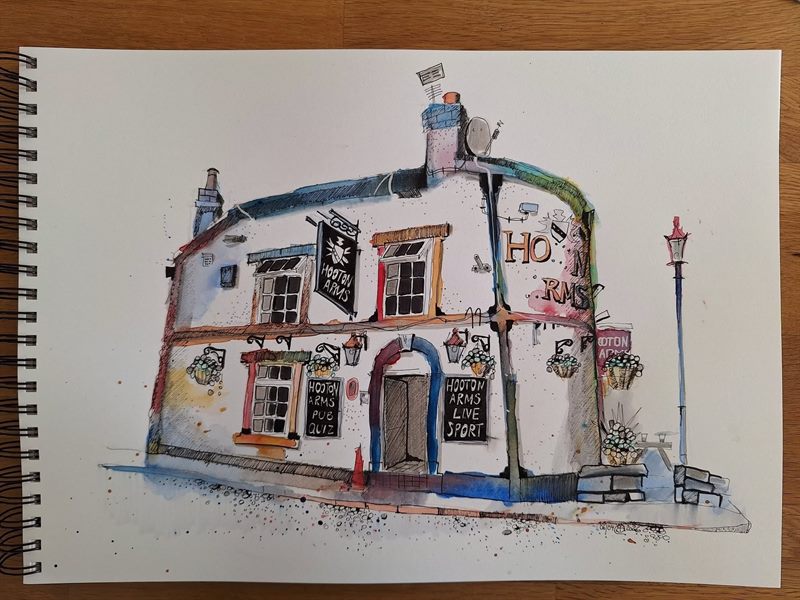
Pub Tour #4 is finished. I really enjoyed it. I didn't use a pencil here either. I'm so glad I had the courage to try it.
Petra Brammertz
More about this course
Pick Up Your Pen. The Pubs Are Waiting.
Join thousands of students who started exactly where you are - curious, maybe a bit nervous, wondering if they could actually do this. They could. So can you.
The Pub Tour
You know the smell. Old wood and furniture polish. The faint ghost of last night's fire in the grate. Hops. The particular warmth of a room that has been heated by human bodies and conversation for longer than anyone can remember.
You know the sound, too - voices dropping to a murmur under low ceilings, the clink of a glass set down on a surface that has held ten thousand glasses before it.
These are the buildings you will learn to sketch. Not sterile modern boxes. The real, scarred, storied pubs that carry centuries of life in their walls. Four of them. Each one different. Each one worth remembering.
St. Patrick's Day Bonus
When you invest in this training, you'll also get this special bonus - absolutely FREE:
30 days
30-day money-back guarantee
If the course is not for you, tell us within 30 days of buying and we will refund you in full.
Ready when you are
- 4 workshops, each a full sketch from first line to last wash
- Lifetime access: watch, pause and rewatch as often as you like
- Resources, reference photos and colour notes to keep
- 30-day money-back guarantee
Join 100K+ people learning with us.
Frequently asked questions
Can I go at my own pace?
Yes - and that's the point. You get lifetime access from the moment you enrol. Watch a module on Monday morning, pick it up again on Thursday evening, revisit it six months later when the mood strikes.
There are no deadlines, no live sessions to miss, no pressure to keep up. The course moves at your speed. Pause, rewind, rewatch - as many times as you like.
Most students find the 15-30 minute lesson segments fit easily into their day.
How is this different from other art courses I've tried?
That's a fair question - especially if you've been burned before.
Debbie Dodge had exactly this experience: "I have taken several courses on line where I follow the instructor step by step. Unfortunately, by the end it seems I can only do what they tell me to do I haven't learned anything. With Ian's course... He shows you what he does and how he makes his decisions so you can learn... I'm just so inspired and feel I have improved 200%."
The difference is that Ian teaches you how to think, not what to draw. His system gives you frameworks you can use on any building, anywhere - not just the one in the tutorial.
What's the Dublin bonus?
During the St. Patrick's Day enrolment window, you receive Ian's Dublin Sketching Bonus Module free with your purchase. This module is normally only available inside Urban Sketch Plus - Ian's premium membership - and can't be purchased separately.
It covers sketching Dublin's iconic architecture - Georgian doors, pub fronts, Temple Bar - using the same system taught in the main course. It's a natural extension: English pubs first, then Irish ones.
What if I don't like it?
You're covered by a full 30-day money-back guarantee. Watch the workshops, try the techniques, sketch a pub. If you're not satisfied - for any reason - you get a full refund. No awkward conversations, no hoops to jump through.
But here's what usually happens instead: you finish that first Wheatsheaf Inn module, look at what you've drawn, and feel something you weren't expecting. A quiet kind of pride. The sense that you've unlocked something that was always there.
That's what our students keep telling us. Not just a course - a spark.